A property has no status — each operation does
The same flat can be for sale, let short-term and under management at once, each operation with its own price, status and client. Everything else grows out of that one rule.
For agencies that sell property to foreign buyers and then manage it for them. The system carries a property through its whole life: sale, handover to management, rental, upkeep.
Ordinary real estate CRMs are built to sell, and they end at the word “sold”. An agency that also manages what it sold buys a bookings program and an invoicing program on top — three systems that do not talk to each other. Between them walks a person copying the same data by hand. That time is invisible on the software invoice and very visible on the payroll.
The same flat can be for sale, let short-term and under management at once, each operation with its own price, status and client. Everything else grows out of that one rule.
Requirements with map zones, a personal shortlist page for the client, viewings, tasks and a deal pipeline. A request from the website creates the client and the agent’s task by itself.
Your own property showcase, a PDF presentation of a listing, and export to idealista and other portals.
Bookings with portal calendars in sync, cleanings with a checklist and photos, payouts to staff, and an owner portal with the monthly statement. This is where an agency’s recurring income lives — and where spreadsheets usually take over.
Invoices with sequential numbering, a fingerprint and a QR code as Verifactu requires, VAT books for modelo 303, bank statement reconciliation from Norma 43 files, and card payments through Stripe Connect.
The contract prints in the client’s language, not the agent’s. If you sell to Germans, Swedes or Poles, that stops being a detail.
Who sees what is decided by the database, not the interface: 128 rules across 54 tables. An employee will not see someone else’s data even by asking for it outside the screen.
Screenshots are in Spanish — that is where the product is sold. The interface switches to seven languages, printed documents included.
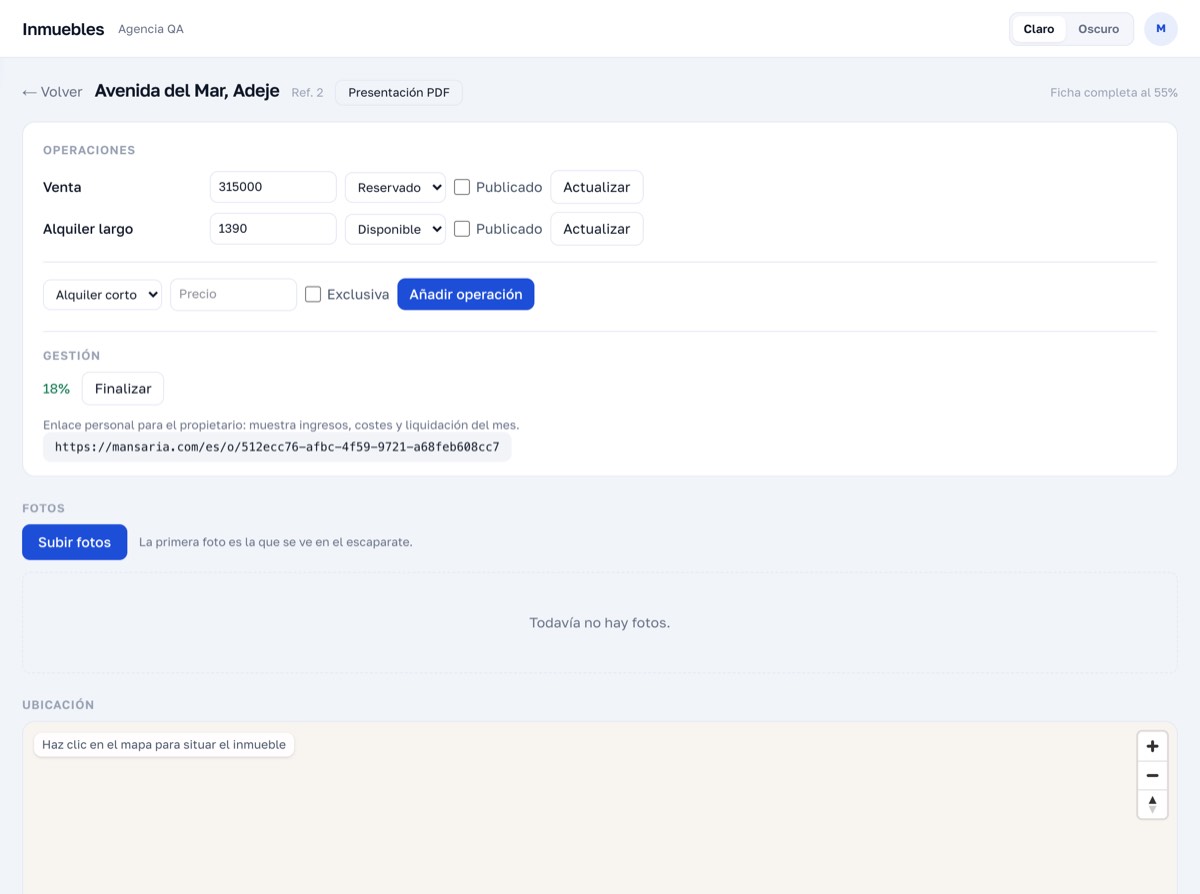
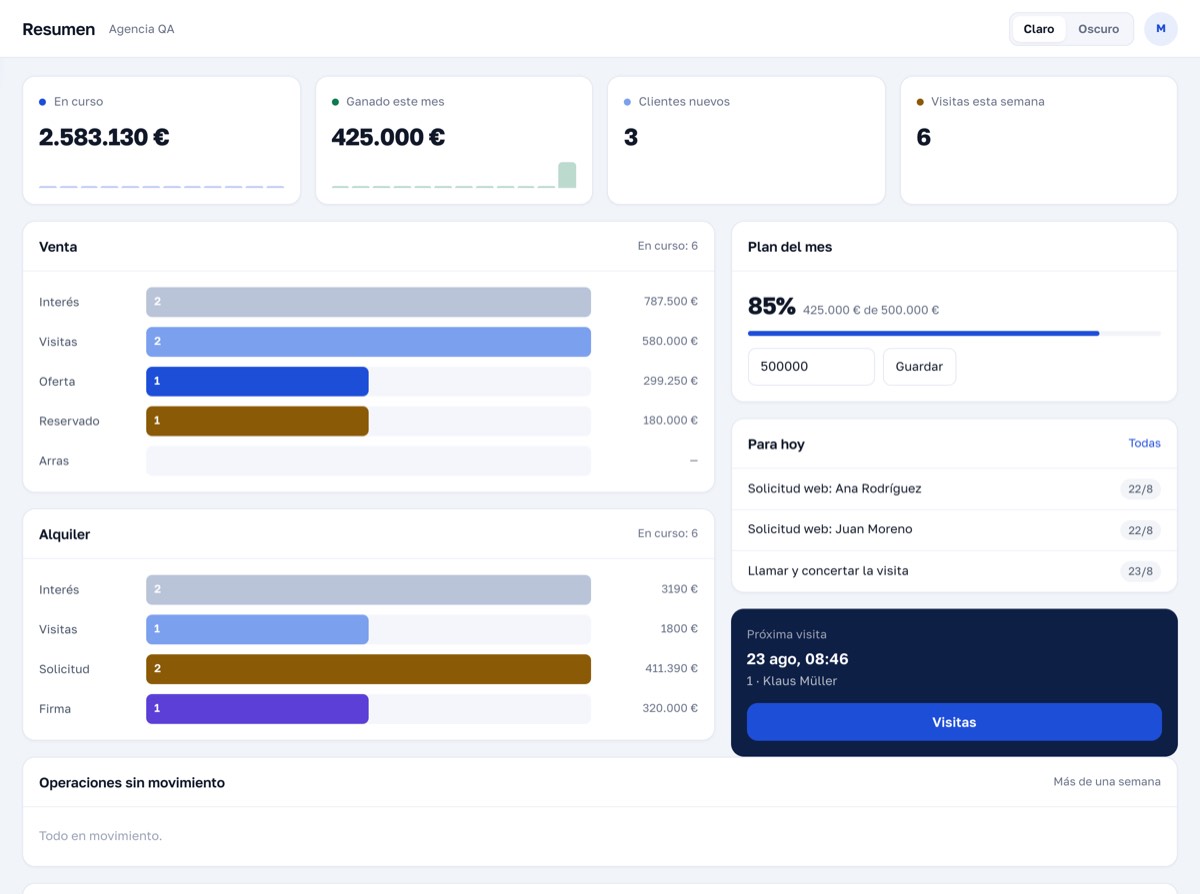
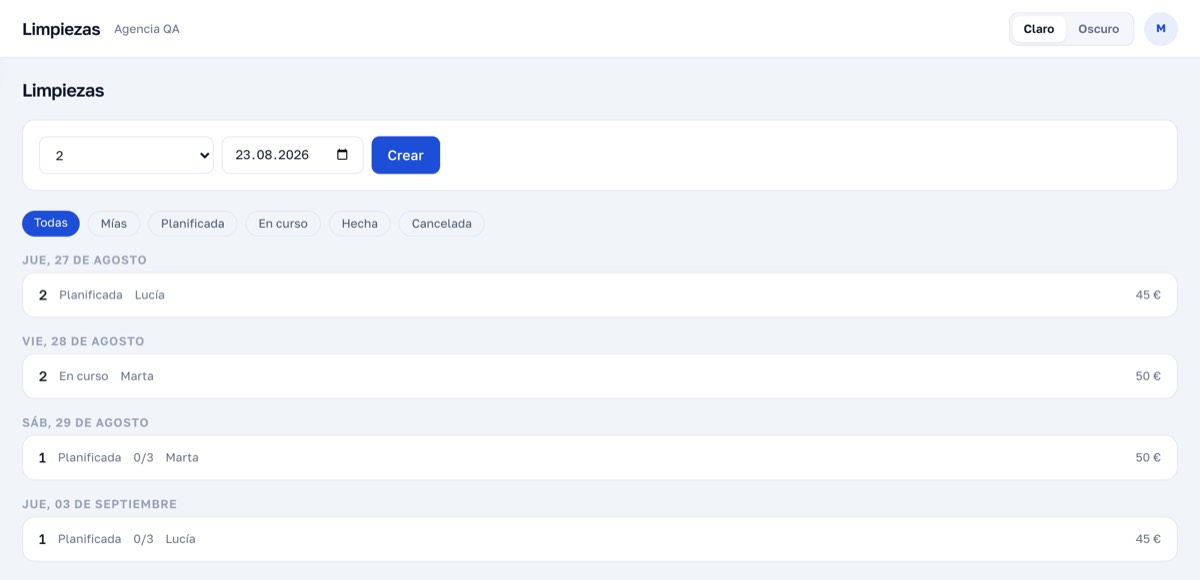
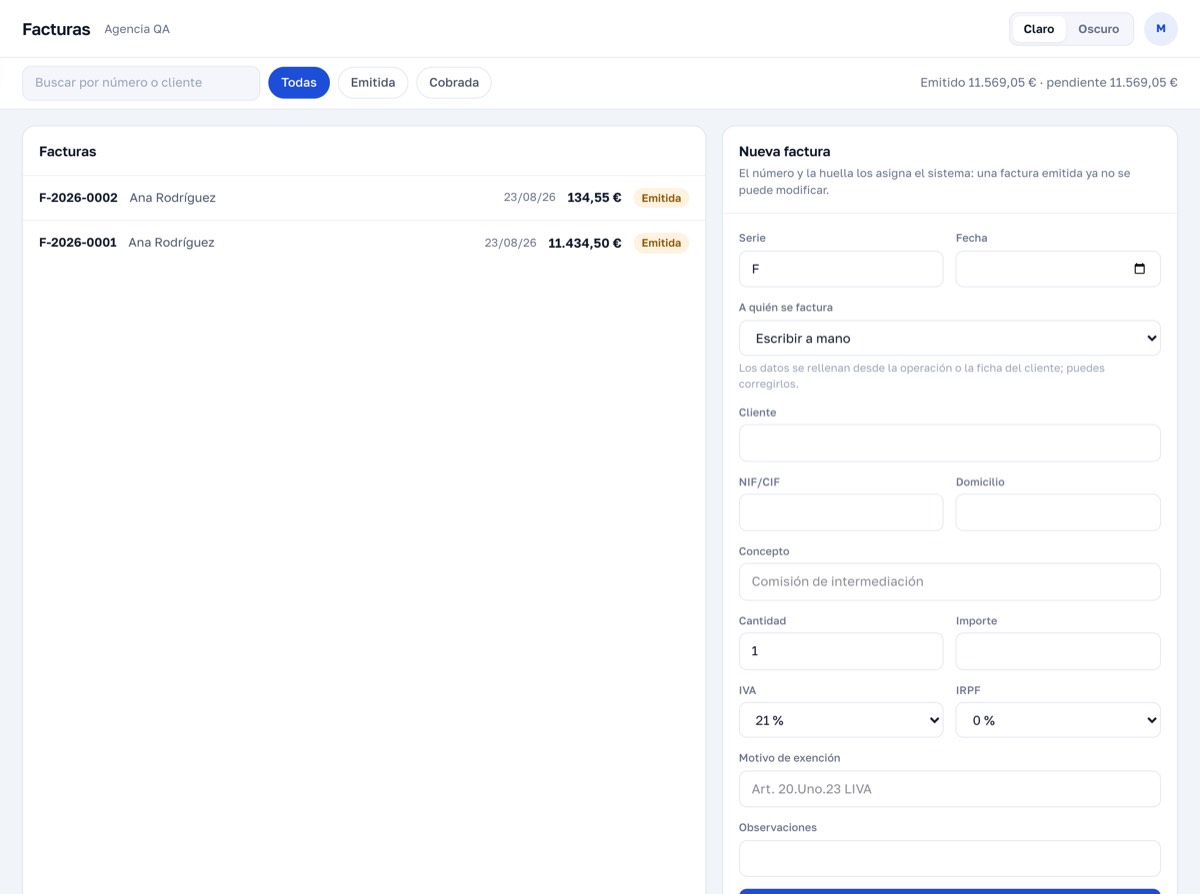
On the left, what an agency usually pays today. On the right, the same thing in one program.
€125–170/mo
typical order of magnitude on the Spanish market
€149/mo
team seats included
On top of those figures come the hours someone spends moving the same data between three programs. They never appear on an invoice.
Compared with the real estate CRMs most used in Spain, based on public information about their products as of August 2026. We deliberately name no one: what their plans include changes, and arguing about someone else’s price list with an agency is a losing conversation. If your program does something on this list, tell us and we will correct it — an uncomfortable table beats an untrue one.
The product is young: the first commit is 18 August 2026. An agency’s full daily round works and has been tested: clients, properties, deals, matching, bookings, cleanings, payouts, the owner portal, invoices and VAT books. Three things are wired up but not yet road-tested — card payments from the agency’s client, sending guest data to the Ministry, and syncing with Smoobu and Lodgify, which was verified against their APIs but not in daily use. None of the three stops anyone working from day one, and we say so before signing rather than after.
Next.js and TypeScript on the interface side, Supabase and PostgreSQL on the data side: 54 tables, 128 access rules, 112 functions and 37 triggers. Eleven external libraries in the whole product is a decision, not an accident: every third-party library brings its own styling, its own localisation and its own update schedule. So the viewings calendar, the interface tour, the bank statement parser, the .ics calendar generator and the invoice QR code are written here.
Send us an export of your properties and clients: we load it before the meeting, so you look at your own agency rather than a demo. We handle the migration from your current program, not your employee.
Fill in the formOpen mansaria.com